OSIsoft PI System™
Connect to OSIsoft PI System™ for industrial data collection and visualization using OIBus with the embedded PI driver in OIBus Agent.
- OIBus Agent must be installed on a Windows machine
- Can be installed on PI Server machine or separate machine with PI SDK configured
Connection Settings
| Setting | Description | Example Value |
|---|---|---|
| Remote agent URL | Agent endpoint URL. Required for all connections. | http://192.168.1.100:2224 |
| Retry interval | Time in milliseconds to wait before retrying the connection. Default: 10000. | 10000 |
Group Settings
Items are organised into groups. Each group defines a shared schedule and the default throttling parameters for historical data retrieval.
| Setting | Description | Example Value |
|---|---|---|
| Name | Unique label for the group within this connector. | Group A |
| Scan mode | Collection schedule applied to every item in the group. | Every 1 min |
Throttling Settings
Throttling controls how OIBus paces historical data requests. These settings appear on each group (for connectors that support groups) or on each item (for single-item connectors). Items in a group can override the group defaults by disabling the Sync with group toggle.
| Setting | Description | Example Value |
|---|---|---|
| Max read interval | Maximum duration of each sub-query in seconds. Larger time ranges are automatically split into chunks not exceeding this value. | 3600 |
| Read delay | Pause in milliseconds between consecutive sub-queries. Helps prevent server overload and manages rate limits. | 1000 |
| Start time offset | Milliseconds added to the start of the query window (@StartTime). A negative value moves the start earlier, to capture late-arriving data from the previous interval — this is the old "Overlap" behavior. A positive value moves the start later instead, skipping that much of the window. | -60000 |
| End time offset | Milliseconds added to the end of the query window (@EndTime). A negative value pulls the end in earlier — useful for eventually-consistent sources where the very latest rows aren't reliable yet. A positive value extends the window later. If the resulting end is not after the effective start, the query is skipped for this run. | 0 |
| Recovery strategy | Order in which OIBus catches up on a backlog of unqueried sub-intervals — e.g. after being stopped for a while, or on first run against a wide time range. From oldest to newest (default) processes the backlog chronologically. From newest to oldest queries the most recent sub-interval first, so up-to-date values become available immediately while older gaps are backfilled afterward. | From oldest to newest |
How Throttling Works
- Interval splitting — A 24-hour range with
Max read interval = 3600(1 hour) is split into 24 separate 1-hour sub-queries. - Read delay — A pause is inserted between sub-queries to manage server load.
- Start/End time offset — With
Start time offset = -60000(-1 minute), a query for[10:00–11:00]actually requests[9:59–11:00], ensuring no late-arriving data is missed.End time offsetshifts the other boundary the same way. - Recovery strategy — Only matters when there's more than one sub-interval to catch up on. With
From newest to oldest, the tracked instant only advances once every sub-interval in the backlog has been queried — this avoids skipping over not-yet-queried older intervals if OIBus restarts mid-catch-up.
Start/End time offset are applied once, to the start and end of the overall query window — not to the start of each individual sub-interval when a large range is split into chunks by Max read interval.
Recommended Configurations
| Scenario | Max read interval | Read delay | Start time offset |
|---|---|---|---|
| Stable network, small datasets | 3600 (1 hour) | 500 | 0 (none) |
| Unstable network | 1800 (30 min) | 2000 | 0 (none) |
| Large historical retrievals | 7200 (2 hours) | 1000 | 0 (none) |
| Real-time with occasional gaps | 900 (15 min) | 200 | -15000 (-15 sec) |
For the reasoning behind these numbers — sizing Max read interval against real data volumes, the Read delay / Max read interval trade-off on a large backlog, and worked examples of Start vs. End time offset (including the batched multi-item case where items don't all flush at once) — see Tuning South History Call Settings.
Each item can override the group throttling defaults by disabling the Sync with group toggle in the item edit form.
Item Configuration
Point Access Methods
| Setting | Description | Example Value |
|---|---|---|
| Type | Access method: PI point (single point by ID) or PI query (multiple points by query expression) | PI point or PI query |
| Point ID | Fully qualified point ID (without server name). Used when Type is PI point. | \\CDT158\SINUSOID |
| Point Query | Query selector for multiple points (see PI Point Query Syntax). Used when Type is PI query. | Name:='SINUSOID' |
- For
PI point: Item name serves as reference in JSON payloads - For
PI query: PI name is used as reference
OSIsoft PI SDK Configuration
Installation Requirements
- Install PI SDK on agent machine
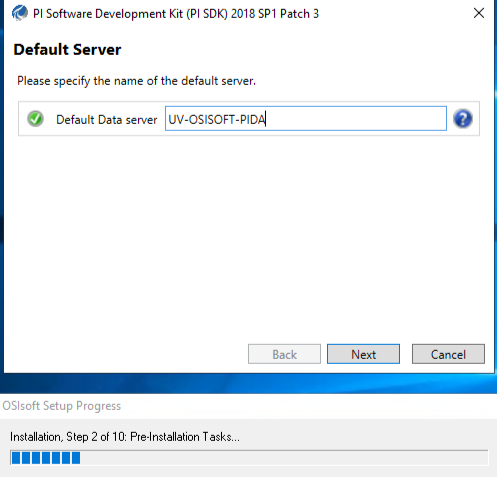
- During installation, specify default data server
- If installing remotely:
- PI SDK must be properly configured
- PI System Access (PSA) must be installed
User Configuration
- Create domain user account (accessible from both machines)
- If domain doesn't exist, create identical local users with same password
- Configure OIBus Agent service to run as this user
Trust Configuration
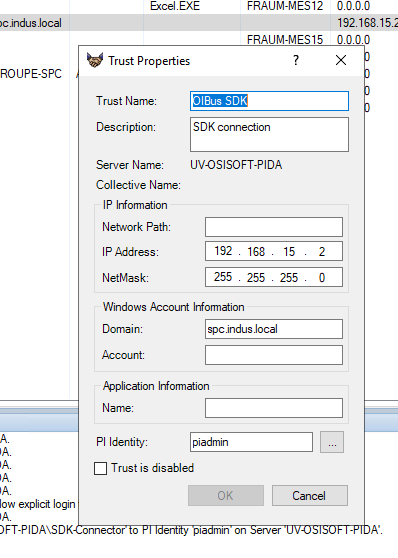
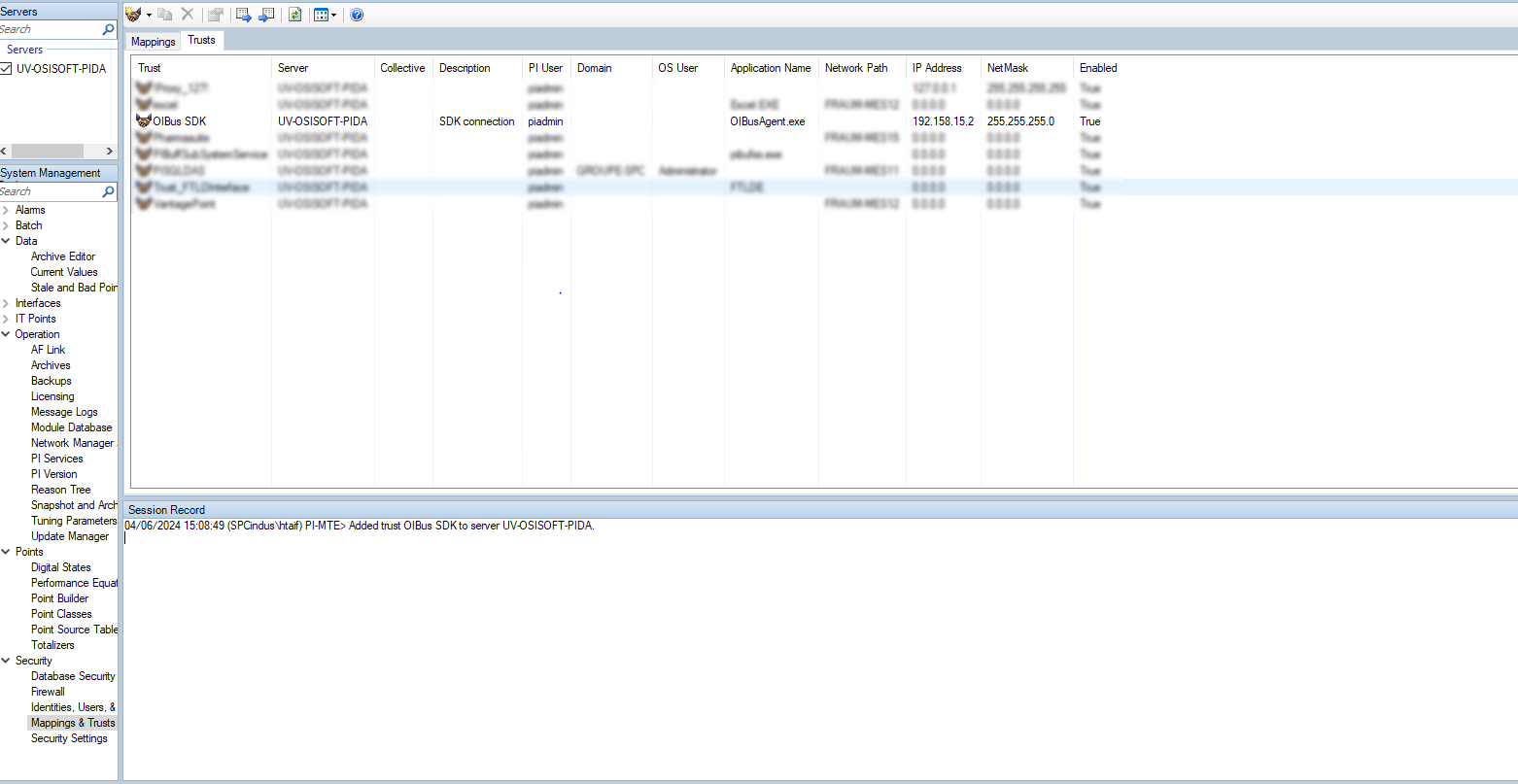
- Open PI System Management Tools
- Navigate to
Mapping & Trusts→Truststab - Create new trust with:
- OIBus Agent machine IP and Net Mask
- Domain (if applicable)
- PI Identity to connect with
Mapping Configuration
- In PI System Management Tools
- Navigate to
Mapping & Trusts→Mappingstab - Create new mapping with:
- OIBus Agent service user
- PI Identity from trust configuration
View system logs in PI System Management Tools:
Operation → Messages Logs
Configuration Screenshots
1. SDK Installation — Specify default data server during installation
2. Trust Configuration — Configure trust for agent machine
3. Trust List — Verified trust configuration
4. Mapping Creation — Map agent user to PI identity
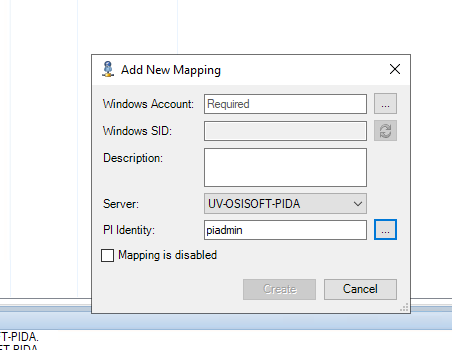
5. Mapping List — Verified user mapping